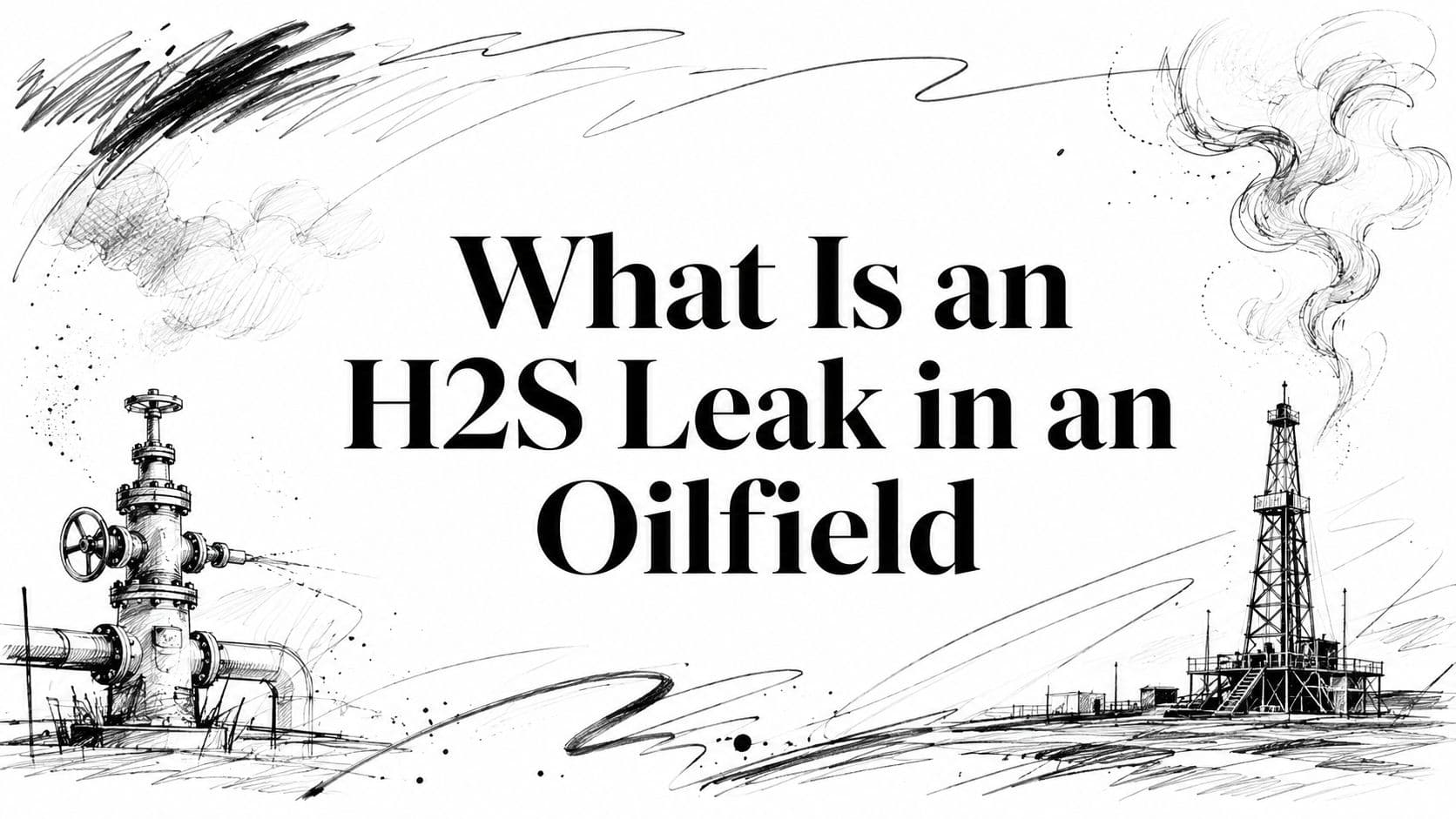
An H2S leak in an oilfield is the unintended release of hydrogen sulfide gas from sour crude, natural gas, or produced-water streams during extraction, storage, transport, or processing. It's treated as an emergency hazard, not a nuisance odor, because the gas is highly toxic, can travel downwind, and can turn deadly fast under the wrong conditions.
A crew may be on a pad in the Permian, a flowback spread in the Bakken, or a water-handling job in the Eagle Ford and never see a spill at all, just a rotten-egg whiff that means the sour stream has escaped somewhere it shouldn't. For owners, supervisors, and hands, that's the same basic question every time, what is an H2S leak in an oilfield, and what do people do when it shows up?
What an H2S Leak in an Oilfield Is
Hydrogen sulfide, or H2S, is a naturally occurring, flammable, and extremely toxic gas that comes out of the petroleum stream itself. It is not a man-made chemical added to the job, it is part of the sour reservoir, which is why sour oil and gas have always demanded more caution than sweet streams.
A leak in oilfield language is any unintended release, whether it comes from a wellhead, separator, produced-water tank, line, valve, or piping connection during extraction, storage, transport, or processing. That can mean a visible release, a vented pocket of gas, or a small invisible escape that still creates a dangerous breathing zone. The U.S. EPA noted that routine H2S emissions from sour wells create exposure potential, while accidental releases can have severe consequences because the gas is highly toxic and can travel significant distances downwind under some conditions.
Sour crude isn't the problem, the gas is
Sour crude is like naturally carbonated water that already has something dissolved in it. The part nobody wants to breathe is the gas that comes off when the system is opened, agitated, heated, or damaged.
Practical rule: if a stream is sour, the leak is not just a product loss issue. It is an air hazard and a worker-exposure problem first.
That matters in the Permian, Eagle Ford, Bakken, and Haynesville, where sour reservoirs are routine enough that crews cannot treat H2S as a rare surprise. It also matters on mobile work, because the release point might not be a dramatic blowout. It may be a small fitting on a separator, a tank hatch, or a line that starts venting when pressure changes.

For a new hire or an operator's safety officer, the clean definition is simple. An H2S leak is an unintended release of toxic sour-gas hydrogen sulfide into the air, anywhere on a site where oil, gas, or produced water is being handled.
Why H2S Leaks Happen on Drilling and Production Locations
Sour gas does not need a dramatic failure to get into the air. It only needs a path, and oilfield work creates plenty of them.
A drilling crew, a flowback spread, or a production crew opens and closes the system all day. Pipe gets tripped, pressure changes, separators are switched, tanks are vented, and lines are broken out for maintenance. Each step can release H2S if the stream is sour and the system is not controlled tightly. A leak is often less like one big event and more like several small openings that line up at the wrong time.
Where the leak actually shows up
On a live location, the gas can come off at the wellhead, around pumps, at piping connections, or from equipment handling produced water. Earthworks notes that H2S can be released during extraction, storage, transport, or processing, which is why a leak is not only one obvious rupture. It can be a series of small release windows that add up to a dangerous exposure (Earthworks oil and gas health brief).
A hot shot truck can pull into a sour pad just as a separator is being swapped. A water hauling crew may be near a tank battery while the wind shifts. A disposal run can turn into an exposure window if the source area has poor ventilation or if gas settles low to the ground. That is why a crew member can walk into a location that looks normal and still step into a problem they cannot see.
Routine release versus accident
The industry often separates routine low-level releases from accidental releases, but crews on the ground have to treat both with the same seriousness. An everyday vent or a small equipment leak can expose workers before anyone realizes what is happening. A larger release can spread downwind and affect people outside the immediate work area, which is why a sour pad has to be managed as a changing hazard zone.
The EPA's congressional report also described routine sour-well emissions as an exposure concern and noted that accidental releases can have severe consequences. That is the part contractors feel after the sirens stop, because the event does not end with the gas cloud. It can trigger shutdowns, evacuation, PPE decisions, incident reports, and later questions about who was exposed, who made the call, and whether the site should have been staged differently (EPA report to Congress).
A sour lease should be mapped like a moving hazard zone. The release point may change with the task, the weather, and the pressure in the system.
That is why experienced crews plan truck routes, staging, and muster points before they step onto the pad. They are not being cautious for show. They are treating each task that opens the system as a chance for gas to escape, and that same mindset matters later when a contractor has to account for downtime, paperwork, and the cost pressure that follows a sour-gas event. For a broader look at how those downstream costs show up, see how oilfield workers are paid.
Health Hazards and the Deception of Odor
A sour pad can fool people at the exact moment they should be most alert. H2S often announces itself with a rotten-egg smell at low levels, and that first scent can make a crew feel like the danger has already been identified.
The nose is a poor safety tool for this gas. About half of people smell H2S at 8 ppb, and more than 90% at 50 ppb, but the sense of smell can be deadened around 150 ppm, which means the warning can disappear just as the hazard turns serious (Earthworks H2S safety facts). OSHA says 100 ppm is immediately dangerous to life or health, concentrations above 500 ppm can cause collapse within five minutes, and levels above 700 ppm can cause immediate collapse and death within one or two breaths (OSHA guidance).
Why the nose stops helping
Olfactory fatigue is easy to explain and easy to ignore. The gas can dull the ability to smell itself, so a worker may say, “It doesn't smell bad anymore,” right when the atmosphere is becoming more dangerous.
That is why odor-based judgment fails on sour locations. Texas guidance says crews in potential exposure areas must monitor continuously, and respiratory protection is required at 100 ppm or higher (Texas Department of Insurance guidance). The limit is not a suggestion, and the body does not pause while someone tries to decide whether the smell still counts.
What the high end looks like
A serious release can move from warning to tragedy fast. The PEMEX Deer Park refinery incident involved more than 27,000 pounds of hydrogen sulfide and caused two fatalities, a clear reminder that H2S events can turn from an exposure concern into a mass-casualty situation before people have time to react (Earthworks H2S safety facts).
Bottom line: if the crew waits for odor to tell them when to act, they are already relying on the wrong signal.

For crews trying to understand pay, rotation risk, and why sour work gets treated differently on site, one related piece is how oilfield workers are paid and staffed in the field. The safety side and the labor side usually move together on sour jobs.
Detection and Monitoring on the Lease
A detector clipped to a hardhat is not there for show. H2S can spread faster than a person can sort out a smell, a wind shift, or a bad assumption.
On a sour lease, the crew needs more than one set of eyes and one reading from one spot. Personal H2S monitors should be worn in areas where gas may be present, air should be tested with the right monitoring devices by a qualified person, and continuous monitoring is the safer standard when exposure is possible. That keeps the crew from relying on odor alone, or on a single detector that only reflects one corner of the pad.
What the gear does
A personal monitor rides close to the breathing zone, so it alarms where the worker stands and breathes. A four-gas monitor gives a broader picture of the atmosphere. A fixed-area detector watches equipment that has a higher chance of releasing gas, such as separators and tanks.
Each device has a different job, like different gauges on a truck dashboard. One warns the person. One checks the space. One keeps watch on the hot spots.
The common mistake is treating an alarm as a simple yes-or-no answer. In the field, the reading, the wind, the task, and how long the crew has been in the area all shape the response. A low alarm can mean it is time to back out and reassess. A high alarm means the crew should move into protective action, not debate what the detector meant.
Reading the alarm as a process
Guidance on graded alerts separates warning from protective action, and site rules often set different levels for low alarm, high alarm, and immediate danger. Some jobs use 10 ppm as a low alarm, 15 ppm as a high alarm, and 100 ppm as IDLH, so detector settings have to match the site plan instead of being copied from another location or another contractor's habits (Jocpr technical paper).
A reading is only the start. Crews still have to ask what changed, where the gas is moving, and whether the leak is growing or settling down.
For contractors running mixed crews, the detector is useful only when everyone knows what the alarm means before the shift starts. If one hand freezes up at the first beep, the whole crew can lose time at the wrong moment.
A clean setup starts with the right breathing protection on hand as well. Crews that need to compare SCBA systems for Canada should do that before they are standing beside sour equipment and trying to make a fast call.

Emergency Response and Evacuation Steps
When an H2S alarm fires, the first job is to stop creating casualties. Everything else comes after that.
The response starts with respiratory protection, then upwind and crosswind movement, then personnel accountability at the muster point. If the source can be isolated without creating more risk, that happens only after the crew is out of the danger area. The scene stays controlled until supervisors and emergency responders can hand it back safely.
The order matters
A trapped worker doesn't get rescued by instinct. A second person running toward the exposure without SCBA can become the next victim, and that's how many H2S incidents turn into multiple-casualty events. The rescue instinct is natural, but H2S punishes it.
Practical rule: if someone is down, the first rescue move is never “go faster.” It's “protect the rescuer first.”
Crews need a buddy system and a standby rescue plan before the job starts. That means people already know who is accounting for the roster, who calls emergency services, and where the muster point is if the wind swings. It also means the team knows not to re-enter until the area is monitored and cleared.
Documentation after the all-clear
Once the immediate hazard is controlled, the paper trail starts. Site notes, detector readings, witness accounts, and supervisor notifications matter because they support investigation and restart decisions later. The practical side of that paperwork is often missed, but it affects whether the next crew can return quickly or wait while the situation is reviewed.
For a side-by-side look at respiratory gear commonly discussed in emergency planning, compare SCBA systems for Canada gives a useful frame for understanding why different jobs need different protection levels.

PPE and Safe Work Practices for Sour Locations
A sour site can feel calm right up until the first rotten-egg whiff drifts across the lease. That smell is a warning, but it is not a plan. The crew still has to choose the right breathing gear, know who can stay in the area, and understand what happens after the alarm sounds and the job stops.
The right respirator depends on the task, the concentration, and how long the crew has to remain in the area. Confusion starts when people treat every breathing device as if it serves the same purpose. An escape unit is for getting out, not for working a line. A supplied-air setup is for controlled work when the atmosphere has been evaluated. SCBA is the gear that belongs in unknown or immediately dangerous conditions.
Respiratory Protection Options for H2S Exposure
| Respirator Type | Suitable H2S Level | Typical Use Case |
|---|---|---|
| SCBA | IDLH or unknown conditions | Entry, rescue, or any situation where the air can't be trusted |
| Full-face pressure-demand supplied-air respirator with auxiliary self-contained air supply | 100 ppm or higher, when site rules and training allow it | Sustained work where the crew still needs a protected air source |
| Escape respirator | Short-term exit only | Walking to the muster point or getting out of the exposure area |
At 100 ppm or higher, Texas guidance calls for a combination full-face pressure-demand supplied-air respirator with auxiliary self-contained air supply. OSHA-related training material also identifies 100 ppm as IDLH, so the respirator choice is tied to the atmosphere, not to preference or convenience (Veriforce summary of OSHA-related benchmarks). The same idea appears in field guidance from Texas Department of Insurance guidance, which is why sour-site crews are expected to match the respirator to the hazard before anyone commits to the work.
What makes PPE work
Fit testing matters because a mask that leaks is just a mask. Seal checks matter because damaged facepiece contact can fail until the wearer needs protection most. Buddy assignments matter because no one on sour work should be the only person watching the air, the alarm, and the exit path at the same time.
A respirator on the truck does nothing for a crew that cannot reach it, inspect it, and use it under stress.
Pre-job H2S briefings keep the crew from guessing about muster points, escape routes, and alarm meanings. They also help supervisors separate entry work from exit-only work, which is where a lot of field confusion starts. The same discipline that keeps a crew organized on a sour location also shows up in other parts of oilfield operations, including paperwork-heavy issues like what double brokering means in oilfield logistics, where missed steps can create their own chain of problems.
Prevention, Training, and Regulatory Compliance
A written H2S plan has to live in the field, not in a binder. Crews need to know who trains them, who signs off their fit tests, and what gets checked before the first line is opened.
The core prevention stack is straightforward. Use a hazard assessment, a control plan, an air-monitoring program, a respiratory protection program, an emergency response plan, worker training, and medical surveillance where occupational health advice calls for it. That structure fits the way sour work is audited, because operators want proof that the contractor can control a hazard before the job starts.
Records that hold up when someone asks questions
Training certificates, fit-test records, calibration logs, and incident reports are the documents that show whether the program is real. If a contractor can't produce them, the site team starts from the assumption that the controls may not be maintained.
A clean audit trail also affects whether a company stays in good standing with operators and insurers. Sour locations are not the place for expired tickets or uncalibrated monitors, and that's why site access often depends on showing a current training file before the rig or crew ever rolls in.
For a related look at how paperwork and compliance can affect the way contractors operate across the supply chain, what double brokering means in oilfield logistics is a useful read.
What operators look for
They want signs that the crew has practiced the response, not just read it. They also want evidence that the contractor's plan matches the actual work being done, especially on sour pads where H2S can show up in more than one part of the operation.
Operational and Financial Impact on Service Contractors
A serious H2S event doesn't end when the alarm stops. It can trigger a work stoppage, an incident review, possible citations, and a stretch of unbilled standby while crews wait to return.
That hits service companies hard because many already invoice on Net-60 or Net-90 terms, which means the operator has 60 or 90 days from the invoice date to pay. When an H2S shutdown interrupts the job, the contractor loses work time first and then still waits on receivables already sitting in the billing queue.
Cash flow after the sirens stop
That's where invoice factoring becomes a practical tool, not a theory exercise. Factoring means a funding company advances cash against unpaid invoices, so the contractor can turn receivables into working capital without taking on a loan. In plain language, it's not a loan, it doesn't create debt, and it doesn't show up on the balance sheet as a liability.
Approval is usually based on the operator's creditworthiness, not the contractor's personal credit score or how long the company has been in business. For owners trying to keep payroll moving, truck fuel paid, and disposal runs covered, that difference matters more than most bank managers realize.
For a closer look at keeping crews paid during long billing cycles, funding for payroll in oilfield service work is worth a read.
Results vary by applicant and are subject to underwriting by the funding partner. OilGasFactoring.com is not a lender, and factoring is not a loan. For qualifying service companies, funding can be available within 24 hours, advance rates can go up to 90% of invoice value, and monthly capacity can run from $50K to $40MM, with a minimum $50K/month in invoices to qualify.
A contractor that handles sour work needs two things at once, a serious H2S plan and a cash flow plan that doesn't collapse when a job gets shut down. Check qualification with OilGasFactoring.com, review a sample funding scenario, and see whether invoice factoring can keep payroll, trucks, and water movement steady while the next safe re-entry decision is being made.