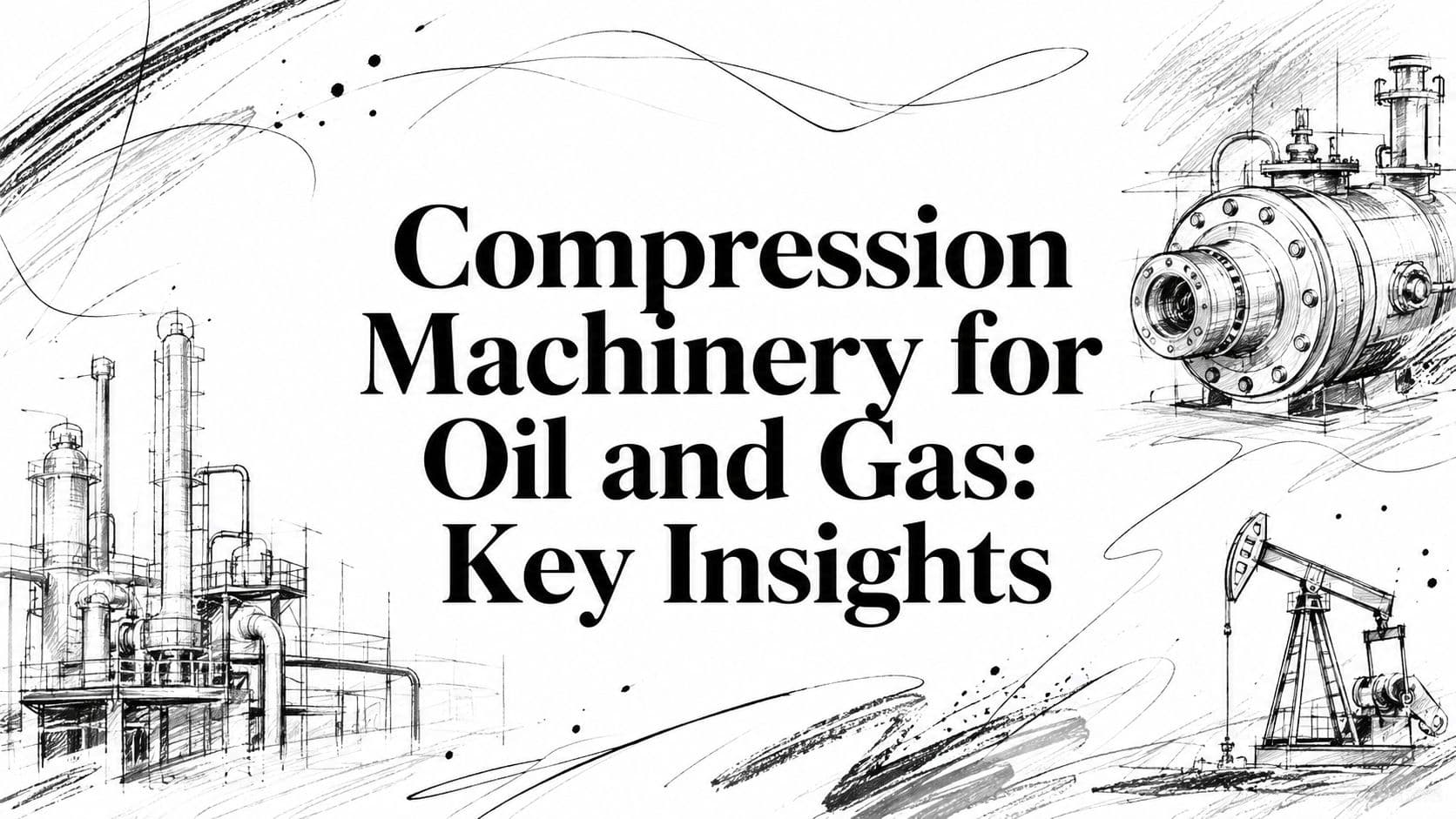
A compressor that was running clean last month can become the whole problem this month. A flowback crew shows up to a lease in the Permian, the gas-lift package lights off, discharge pressure starts wandering, and the operator still wants the gas moved because the line is open and the invoice clock is already ticking. That is the reality behind compression machinery for oil and gas, a piece of equipment that looks like one more skid until it stops, then becomes the reason gas is flared, shut in, or delayed from sale.
What Compression Machinery for Oil and Gas Actually Does
On a pad in the Permian, a gas-lift package can sound like a small storm. Suction gas comes off the wellhead, the unit raises that gas to a usable pressure, and discharge heads toward a sales line, a gathering system, or a reinjection point. The machine sitting there is not just “compressing gas,” it is bridging the pressure gap between what the well makes and what the system demands.

At a practical level, compression machinery for oil and gas means any device that raises the pressure of hydrocarbon gas or vapor so it can move through gathering, enter a pipeline, lift liquids, or be reinjected. That function shows up in artificial lift, gas gathering, vapor recovery, and gas processing, and each service puts a different stress pattern on the machine.
The financial side is not abstract. A DOE-backed industry overview says the U.S. has about 1,700 midstream natural gas pipeline compressor stations with 5,000 to 7,000 compressors, plus roughly 13,000 to 15,000 smaller compressors in upstream service and another 2,000 to 3,000 in downstream oil and gas and LNG applications, and compressors consume or leak away about 2% to 3% of U.S. natural gas, equal to roughly 0.7 Tcf per year and about $3 to $4 billion annually at typical gas prices DOE-backed industry overview. That is why compression is not an accessory. It is a foundational operating cost and reliability issue.
Practical rule: if the compressor goes down, the reservoir may still be there, but the cash flow often isn't.
The same setup can be the difference between a producing lease and a shut-in one. A wellhead may flow at a low pressure while the gathering line runs much higher, and the compressor is the thing that makes the system connect. In that sense, it is not only a machine. It is the hinge between production and revenue.
More field context on oil and gas machinery
The Four Main Types of Compression Machinery in Oilfield Service
Different compressor families solve different problems, and that starts with how they move gas. A field crew that treats every package as the same usually ends up with too much horsepower, not enough turndown, or a machine that looks good on paper and behaves badly on location.
Reciprocating Compressors
A reciprocating compressor works like a piston pump. Cylinders move gas in discrete strokes, so the unit handles higher pressures well and tolerates variable flow better than many other options. That makes it a strong fit for gas lift, gathering, and reinjection service where the duty can swing with well conditions.
Centrifugal Compressors
A centrifugal compressor behaves more like a spinning fan with serious discipline. An impeller throws gas outward, which makes these machines a better match for high-volume, steadier duty in pipeline boosting and gas processing. The verified data notes that API 617-certified centrifugal compressors in oil and gas service are typically expected to deliver measured efficiency at least 98% of the predicted certified-point value, and modern integrally geared designs can reach 80%+ efficiency because each impeller can run at its optimal speed while intercooling between stages moves the process closer to isothermal behavior Texas A&M research PDF.
Rotary Screw Compressors
A rotary screw compressor uses two meshing rotors to move gas continuously. In oilfield work, that steady output is useful in vapor recovery, smaller gas-lift packages, and instrument air service. These units are usually chosen when the job needs smooth delivery and less pulsation than reciprocating equipment.
Gas-Turbine-Driven Packages
A gas-turbine-driven package is a compressor driven by a turbine engine. In remote stations, the appeal is simple, the site can use available gas and keep the package self-contained. The trade-off is higher packaging complexity and more variables to manage in the field.
| Compressor Type Comparison for Oilfield Service | ||||
|---|---|---|---|---|
| Type | Typical HP | Pressure Ratio | Best Fit Duty | Key Trade-Off |
| Reciprocating | Lower to mid-range packages, often used where pressure needs are high | High | Gas lift, gathering, reinjection | Strong pressure capability, more pulsation and maintenance attention |
| Centrifugal | Mid to very high horsepower packages | Moderate to high | Pipeline boosting, processing | Efficient at steady flow, less forgiving when the duty swings |
| Rotary Screw | Smaller to mid-size packages | Low to moderate | Vapor recovery, instrument air, smaller gas lift | Smooth flow, not the right choice for every high-pressure service |
| Gas-Turbine-Driven | Varies by installation | Varies by train design | Remote field packages | Good for self-contained sites, but packaging and fuel use matter |
A buyer usually gets into trouble by asking, “What type of compressor do we want?” The better question is, “What pressure, flow, and operating pattern does the service actually require?”
Compression choice gets easier when the duty is clear. It gets harder when the project owner wants one machine to behave like three different machines.
Matching Compressor Type to Oilfield Application
The cleanest way to spec a compressor is to start with the service, not the brand of iron. Wellhead and field gathering, pipeline boosting, gas lift, gas reinjection, and vapor recovery each place a different demand on the machine, and the wrong match usually shows up later as wasted fuel, unstable pressure, or maintenance that arrives too often.
Match the Duty First
Low to moderate pressure with variable flow usually points toward reciprocating or rotary screw equipment. That is common in gathering lines and field gas services where the compressor has to ride through changing well conditions. Steady, high-volume work in transmission or mainline boosting leans toward centrifugal or turbine-driven centrifugal trains.
Gas lift is a different animal. The service wants stable pressure, reliable start-up behavior, and a machine that can keep doing the same job day after day. Reciprocating equipment tends to fit there because it handles higher ratios and changing demand more gracefully than a lot of general-purpose packages.
Respect the Gas Stream
Gas composition matters just as much as pressure. Sour service, wet gas, and gas with carryover create wear, contamination, and sealing problems that a clean stream would not. A vapor-recovery unit that sees light hydrocarbon vapors all day is not living the same life as a reinjection compressor taking conditioned gas from a treatment train.
The same nameplate can hide very different operating realities. A compressor built for clean, steady gas can become a problem machine the moment liquids or contamination show up.
That is why application comes first. A project team that asks about inlet pressure, ratio, contaminants, and runtime can usually narrow the field fast. One that starts with horsepower alone often buys the wrong capability and spends the rest of the project trying to work around it.

Sizing and Performance Factors That Drive Compressor Selection
Sizing a compressor starts with four levers, and every one of them changes the result. Flow rate, suction pressure, discharge pressure, and gas composition each affect horsepower, stage count, rod load, and cooling needs. If one of those inputs is wrong, the package can be undersized without ever looking obviously small.
The Four Levers That Matter
Flow rate tells the machine how much gas has to move. Suction pressure tells it how hard the gas is already being pushed. Discharge pressure tells it what the system needs on the other end. Gas composition tells the engineer how the gas behaves, especially when it contains moisture, hydrogen sulfide, carbon dioxide, nitrogen, or heavier components.
A simple field example helps. A gathering system pulling 5 MMSCFD from 50 psig up to 250 psig with gas around 0.65 specific gravity is not a brochure exercise. It needs a performance map at that exact operating point, with the actual gas properties and ambient conditions applied, not just a generic curve pulled from a catalog.
Derating Is Not Optional
Hot weather, altitude, fouled coolers, and rich gas all cut real-world capacity. Engineers treat those as derating factors because a compressor that looks fine on a cool day at sea level can lose useful output once it is sitting in summer heat, on a dusty pad, or handling a heavier gas mix. The machine has to be sized for the environment it will live in.
The compressed-air guidebook used here makes the general point clearly. It reports reciprocating compressors at 10 bar and two stages at about 21.74 kW/100 cfm, while another benchmark shows centrifugal compressors around 0.12 kW/CFM, and it notes that reciprocating compressors may still retain 76% to 77% of full-load power at 75% load Compressed Air System Guidebook. The lesson is not that one machine is always better. It is that part-load behavior can erase the savings a spreadsheet promised.
| Compressor Sizing Levers and Their Typical Effect | |||
|---|---|---|---|
| Performance Lever | What It Controls | Typical Range in Oilfield Service | Effect on Unit Selection |
| Flow rate | Volume the machine must move | Small wellhead service to large gathering trains | Drives frame size and driver load |
| Suction pressure | Starting pressure at the inlet | Low-pressure field gas to conditioned inlet gas | Changes compression ratio and stage demand |
| Discharge pressure | Pressure required at outlet | Lift, gathering, reinjection, pipeline boost | Sets horsepower and may require more stages |
| Gas composition | Wetness, sour content, heavies, and inert gas | Clean gas to contaminated field gas | Affects materials, sealing, cooling, and reliability |
A good sizing package is not the one with the prettiest curve. It is the one that still works when the pad gets hot and the gas gets ugly.
Buying Versus Renting Compression Equipment
The buy-versus-rent decision usually turns on four questions. How long is the project, how much capital is available, who eats mobilization risk, and who owns the maintenance headache once the unit is on site. Those questions matter more than whether the iron looks attractive on a quote sheet.
Buying Makes Sense When the Work Stays Put
Buying can mean a $1 million to $5 million+ capital outlay, but it also gives full control over the package, the maintenance plan, and the operating standard. That works when the company has recurring duty, a stable gas stream, and enough internal support to handle parts, crews, and redundancy. A permanent gathering system or multi-year compression contract can justify that kind of commitment.
Renting Buys Time and Flexibility
Rental often wins when the project is still being proved out. A unit can be moved in faster, the operator avoids upfront ownership cost, and the contractor can step away when the work ends. The trade-off is that contract terms, return conditions, and downtime liability vary, so the rental deal has to be read carefully before anyone signs.
A usable rule is simple. If the gas composition is uncertain, the flow is still changing, or the gathering plan is temporary, renting often protects the balance sheet better than buying a package that may not stay busy.
Used oilfield equipment considerations

| Buying vs. Renting Compression Equipment | |||
|---|---|---|---|
| Decision Filter | Buy | Rent | Practical Read |
| Project duration | Better for long-running service | Better for short-term work | Match the asset to the job length |
| Capex availability | Requires cash or financing | Low upfront burden | Rental protects liquidity |
| Mobilization | Ownership makes sense when the unit stays busy | Better when moves are frequent | Relocation cost can swing the decision |
| Maintenance | In-house team carries the load | Contractor-managed in many cases | Maintenance responsibility is a hidden cost |
Cost Ranges, Operating Economics, and ROI
The sticker price on a compressor matters, but it does not drive the whole return. Fuel or electric power, maintenance and consumables, downtime exposure, and residual value all shape whether the unit earns its keep. In many packages, power cost dominates the long-term picture.
What Moves the Economics
A 1,000 hp natural gas-driven compressor typically burns 7 to 9 MMBtu/hr, while a 500 hp electric unit pulls roughly 2 to 3 kWh per MCF compressed. Those two figures do not tell the whole story, but they do show why fuel choice and driver type can make a project feel cheap in one setting and expensive in another.
Owned units carry more control and potential resale value, but they also carry repair exposure and spare-parts planning. Rental shifts some of that burden to the provider, though the monthly bill keeps running whether the unit is busy or not. A project manager who ignores downtime in the model is not building ROI, only a wish list.
A Simple Payback Frame
A $2.5 million owned compression package earning roughly $0.35 to $0.60 per MCF through a gathering or compression-services contract can pencil well if it stays loaded and stays online. A comparable rental may run roughly $15,000 to $25,000 per month all-in, which can still make sense if the work is temporary or the operating profile is uncertain. The right answer depends on utilization, fuel variability, and the contract term.
ROI gets distorted when the model assumes the compressor runs at perfect load, in perfect weather, with zero interruptions. That is not field life.
The only honest model loads the cost of power, maintenance, and expected downtime before anyone calls the project a winner. If those pieces are missing, the payback estimate is too clean to trust.
| Owned vs Rented Compressor Economics at a Glance | |||
|---|---|---|---|
| Cost Driver | Owned Compression Package | Rented Compression Unit | Notes |
| Upfront capital | Higher | Lower | Ownership ties up cash |
| Power and fuel | Paid by operator | Often folded into rental terms or still billed separately | Review the contract carefully |
| Maintenance | Owner-managed | Often provider-managed | Responsibility can shift risk |
| Downtime exposure | More direct exposure | Shared or contract-defined | The fine print matters |
| Residual value | Potential recovery at resale | None | Ownership can leave an end value |
Installation, Maintenance, Safety, and Financing the Cash Gap
A compressor package is only useful after it is installed correctly. Pad prep, foundation work, skid setting, piping, instrumentation tie-ins, and commissioning checks all have to line up before the unit can be trusted on a live system. Miss one of those pieces and the first weeks of operation can turn into troubleshooting instead of production.
Keep the Maintenance Routine Boring
Routine care usually means oil changes, valve inspections, vibration monitoring, filter swaps, seal checks, and cleanup around the cooler and suction train. The point is not to make the unit glamorous. The point is to keep small issues from turning into expensive shutdowns. Compressor packages in oilfield service are commonly built around API 618 and API 11P standards, so the maintenance program has to respect the package design instead of treating every unit like generic shop equipment.
Safety and regulatory work matters just as much. Engine emissions have to meet EPA NSPS and state rules, leaks have to be watched under 40 CFR Part 60 Subpart OOOOa, relief valves need proper sizing, and area classification has to match the installation. These are not paperwork items. They shape how the package is built, operated, and inspected.
The Cash Gap Is Real
The operating reality for service contractors is simple. Fuel, crew time, mobilization, and parts hit day one, while operator payments often arrive on 60- to 90-day terms. In the Permian, and in other basins like the Eagle Ford, Bakken, Haynesville, Marcellus/Utica, DJ Basin/Niobrara, SCOOP/STACK, and Gulf of Mexico, that gap can squeeze even a busy company.
A workable financing tool is invoice factoring, which is the sale of unpaid receivables rather than a traditional loan. It does not create debt, it does not appear on the balance sheet as a liability, and approval is based on the creditworthiness of the customer being invoiced, not the applicant's credit score or years in business. A standard workflow is straightforward, the contractor completes the work, submits the invoice, the factor verifies the invoice and the customer, then advances cash against it, often within 24 to 48 hours invoice factoring workflow. Another accounting source says the advance is often 80% to 95% and is usually received within 24 hours factored invoice accounting.
Aftermarket services for oil and gas machinery
| Comparing Financing Options for Compressor Operations | |||
|---|---|---|---|
| Factor | Invoice Factoring | Bank Line of Credit | Merchant Cash Advance |
| Speed | Often fast once invoices are verified | Slower, more paperwork | Fast, but expensive capital |
| Qualification focus | Customer credit and invoice quality | Borrower strength, collateral, banking history | Daily cash flow and card or revenue collection patterns |
| Balance sheet impact | Not a traditional loan, no new debt from the sale of receivables | Debt on the books | Usually treated as a financing obligation |
| Best fit | Contractors waiting on slow-paying operators | Firms with established banking relationships | Short-term bridge needs with very high tolerance for cost |
Factoring fees are commonly priced by invoice age. One guide lists recourse factoring fees at about 1.0% to 2.5% for invoices paid in 1 to 30 days, 2.0% to 3.5% for 31 to 60 days, 3.0% to 4.5% for 61 to 90 days, and 4% to 6%+ for 91+ days invoice factoring fee guide. That is why the comparison is not just fee versus interest. It is speed, paperwork, and whether the business can keep crews moving while invoices age.
A Practical Next Step for Operators and Contractors
The next decision should be simple enough to write on one page. Identify the service duty, match it to the right compressor family, decide whether the work justifies buying or renting, and then make sure the cash plan can carry the invoice gap. A compressor that fits the gas stream but starves the company of working capital is still the wrong choice.

For service contractors, the first screening question is whether monthly invoiced revenue reaches the typical $50,000 per month minimum many factoring programs use to qualify. That is not a promise of approval, and it is not a promise on rate. Results vary by applicant and are subject to underwriting by the funding partner.
The useful documents are already in the office, if someone pulls them together. An AR aging report, compressor logs, tax ID, and equipment list tell the funding side what is happening in the business. A no-obligation quote should also spell out the advance rate and reserve handling before any hardware, crew, or schedule is committed.
The cleanest compression plan pairs the right machine with the right cash plan. One without the other usually creates trouble later.
OilGasFactoring.com helps oilfield service contractors turn unpaid invoices into working capital while they wait on operator payment. If compressor work is tying up cash in 60- to 90-day billing cycles, visit OilGasFactoring.com to check qualification, review advance options, and see whether factoring is a fit for the invoices already on the books.